When people think about building a custom home, they picture the kitchen, the layout, the finishes. Rarely do they think about the air. But the air inside your home may be the most important thing you never see and in a high-performance custom build, it’s something we take very seriously.
The Problem With Airtight Homes
Modern high performance homes are built tight. That’s a good thing for energy efficiency but it creates a real challenge. Without a deliberate fresh air strategy, a well sealed home traps stale air, moisture, cooking odors, VOCs off gassing from furniture and finishes, and elevated CO₂ from everyday living.
Over time, that affects how you sleep, how you feel, and how healthy your home actually is. Opening a window isn’t a solution, especially in the Fraser Valley, where wildfire smoke seasons are getting longer, pollen counts are high, and damp winter air brings its own set of problems.
What the BC Building Code Actually Requires (And What It Doesn’t)
Here’s something most homeowners don’t know: the BC Building Code has required fresh air ventilation in all new residential homes since December 2014, under Section 9.32. The old “exhaust only” system, a bathroom fan pulling stale air out while fresh air drifted in through gaps around doors and windows, was officially retired.
The code now requires a principal ventilation system that both exhausts stale air and supplies fresh air to bedrooms and living areas.
But, and this is important, the code does not require a Heat Recovery Ventilator (HRV).
Builders can satisfy Section 9.32 through several compliance paths: a furnace with a passive fresh air intake, a central recirculation ventilator, or even passive wall vents in smaller homes. These approaches check the legal box. They do not deliver the same air quality or energy performance as a properly installed HRV.
Many builders choose the cheapest compliant path. That’s how you end up with a brand new home that technically meets code but where the ventilation system isn’t actually doing much for the people living inside it.
Enter the HRV
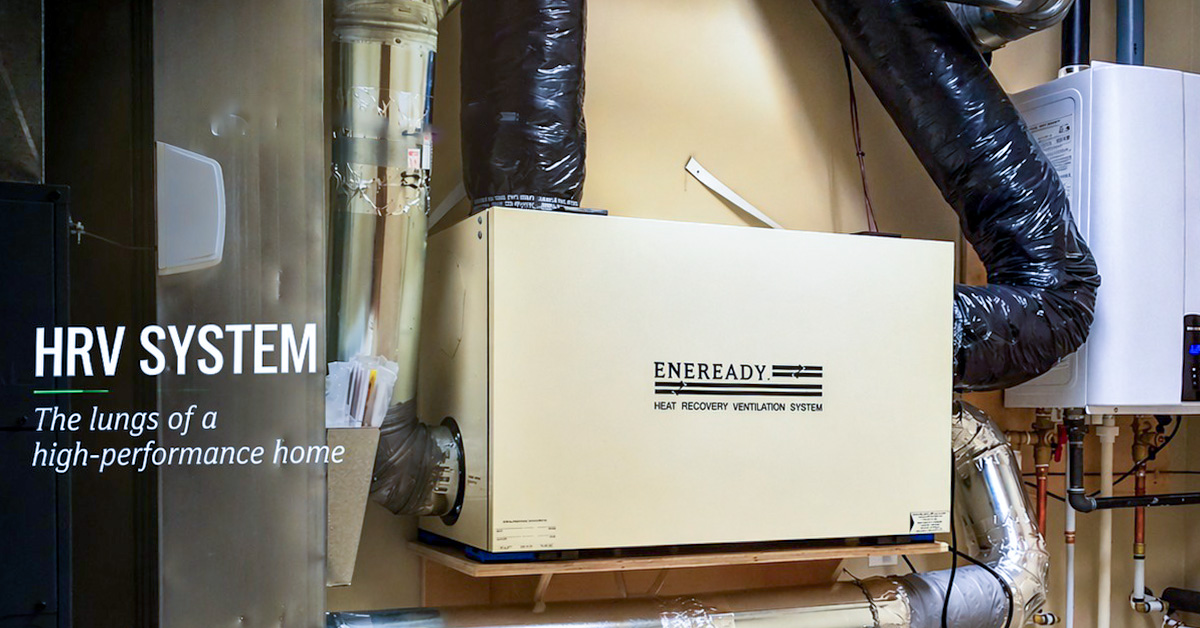
A Heat Recovery Ventilator (HRV) is the lungs of a high performance home. It works by continuously exhausting stale indoor air while simultaneously drawing in fresh outdoor air running both streams through a heat exchange core. In that core, up to 80% of the heat energy from the outgoing air is transferred to the incoming air before it ever enters your living space.
The result is continuous, filtered, fresh air without the energy penalty of simply opening a window or relying on a passive vent. Your home breathes constantly and quietly, and your heating system isn’t working overtime to condition cold, untempered air rushing in from outside.
An HRV is sized to your home’s floor plan, integrated with your ductwork, and balanced during commissioning so that supply and exhaust airflows are matched. Done right, it operates invisibly in the background and you notice it only through the quality of the air you’re breathing.
What That Means Day to Day
- Better sleep. Elevated CO₂ is one of the most common and most overlooked causes of poor sleep quality. Continuous fresh air keeps CO₂ levels low overnight, supporting deeper, more restorative rest.
- Reduced allergens. Filtered incoming air limits pollen, particulates, and outdoor pollutants from entering your living spaces.
- Moisture control. Balanced ventilation removes excess humidity before it can condense on surfaces or contribute to mold growth which is a real concern in the Fraser Valley’s damp winters.
- Odor free living. Cooking smells, off gassing from new materials, and everyday household odors are continuously flushed out rather than recirculated.
The Sonbuilt Standard
At Sonbuilt Custom Homes, meeting code minimum has never been our benchmark. We specify HRV systems in every home we build because we believe a custom home should perform, not just comply.
We don’t treat ventilation as a checkbox. It’s engineered into the home from day one, designed alongside the building envelope and mechanical systems so everything works together the way it should.
Because a home that takes care of the air inside it is a home that takes care of you.
Ready to build a home that performs from the inside out? Let’s talk! Contact Sonbuilt Custom Homes today.